Ade Adepitan's 'I'm A Celebrity': What It Means for Accessible Travel
When Ade Adepitan MBE enters the fabled jungle camp of I’m A Celebrity this November – alongside stars such as footballer Wayne Rooney, actress Claire Sweeney and musician Ricky Wilson of Kaiser Chief fame – he’ll actually have been there before. Months ahead of broadcast, the production team behind the show flew the Paralympian and documentary maker to Australia to work together on making the camp and its infamous challenges accessible.
That’s worth sitting with. Because it describes a level of listening and inclusive design that, sadly, doesn’t always happen in our culture or, indeed, the world of accessible travel.
"It is amazing for me to think that I'm going to be the first wheelchair user to go into the Jungle." - Ade Adepitan MBE
What accessibility changes did ITV make to the I’m a Celebrity jungle?
- Pathways widened and deepened throughout the camp so a wheelchair could actually move through them, not just technically fit
- Wheelchair bays at key transfer points, so he could switch between his chair and crutches as he would anywhere else
- Rest areas added along the route from camp to creek
- A stairlift built into the jungle shower
- The treehouse — a fixture of the show for years — replaced with a swing area that he could actually use
- Five pieces of mobility equipment on site: a day-use wheelchair, a trials wheelchair, an electric wheelchair for harder terrain like sand, and three pairs of crutches
Adepitan visited the site nine months before filming to work through these decisions with the production team. Some trial adaptations were small — an extra handle here, a footgrip there. Others required rebuilding parts of a set that had existed for years.
What this tells us about accessible travel
The jungle camp is not a hotel. If it were, Ant and Dec might well be the worst general managers of all time. But the approach ITV took maps almost exactly onto what genuine accessibility looks like in any setting.
- Genuine access is designed around the person, not retrofitted for them. The production team didn’t hand Ade a list of what the existing camp could offer and ask him to manage. They asked him what he needed, then changed the camp. That sequence matters.
- It requires investment before arrival. Planning time. A site visit. Structural changes. Specialist equipment. The access didn’t appear on the day — it was built in advance, specifically.
- Small adjustments count. Not every adaptation was a major rebuild. An extra handle on a trial course is a small thing. But it’s often the small things that determine whether someone can participate at all.
- It has to come from wanting someone to succeed. The producer’s of the show put it best — “we really wanted to set him up to succeed”. This describes a perspective, not just a process. Checklists and compliance documents don’t just produce an accessible place. Care about the guest’s experience does.
While hopefully starting many conversations around accessibility in our culture, this season of ‘I’m a Celebrity’ sets a high bar. Many settings, including those providing so-called “accessible” travel options, fall short. That’s worth being honest about, so we can use this moment to listen, learn and move forward in a more inclusive way.
How we do it at Calvert Kielder
Calvert Kielder is an inclusive holiday, outdoor activity and retreat centre, set within Kielder Water & Forest Park. For 40 years we’ve built accessibility into the foundation of everything that we do so, whether you have multiple access needs or none, everyone can experience the power of nature with us.
In practice, that means:
- Accommodation built for a range of access needs. We’re all built differently and so are our lodges. If you need profiling beds, adjustable kitchens and bathrooms, hoists, wet rooms, wide doorways – we’re all ready for you.
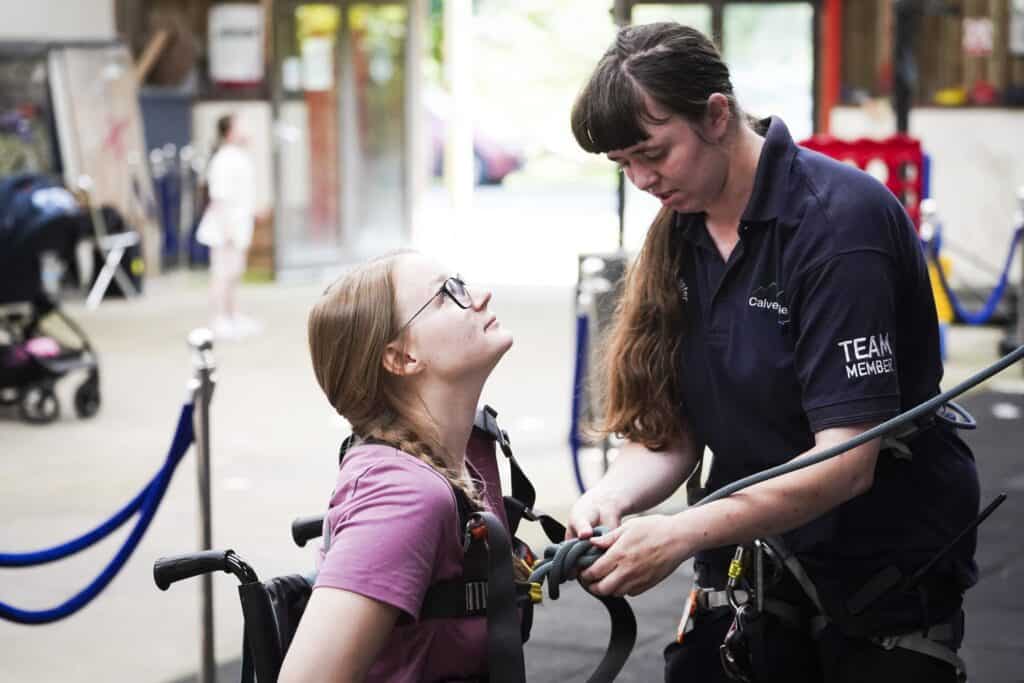
- Our activity programme is designed to be used by everyone, not observed. Sailing, kayaking, bushcraft, cycling, archery, climbing — all the activities are adapted so that disability doesn’t mean watching from the sideline.
- We plan around the individual. Before you arrive, we talk through what you need. What equipment you use. What works and what doesn’t. What you want to try. The holiday takes shape around you.
- Our staff are trained specifically for supporting guests with complex physical needs — not general customer service staff asked to cover accessibility.
- The setting itself — 40 acres of woodland in Northumberland’s Kielder Water & Forest Park is all designed to be usable. Paths. Terrain. Access to the water
It’s the same logic as ITV’s approach, in a very different setting: start from wanting the person to fully take part, then build backwards from there.